Asset inventory on a multi-hundred-instrument lab move works by giving every single item a tracked identity before it’s packed, so it can be checked off at pickup, in transit, and again at delivery. CG Moving Company used exactly this approach on our Europe-to-South San Francisco lab relocation case study, a project involving more than 140 instruments and assets. Without that level of tracking, a move this size turns into guesswork.
How do you start an inventory for a move this large?
Tagging every asset with a unique ID before any packing starts.
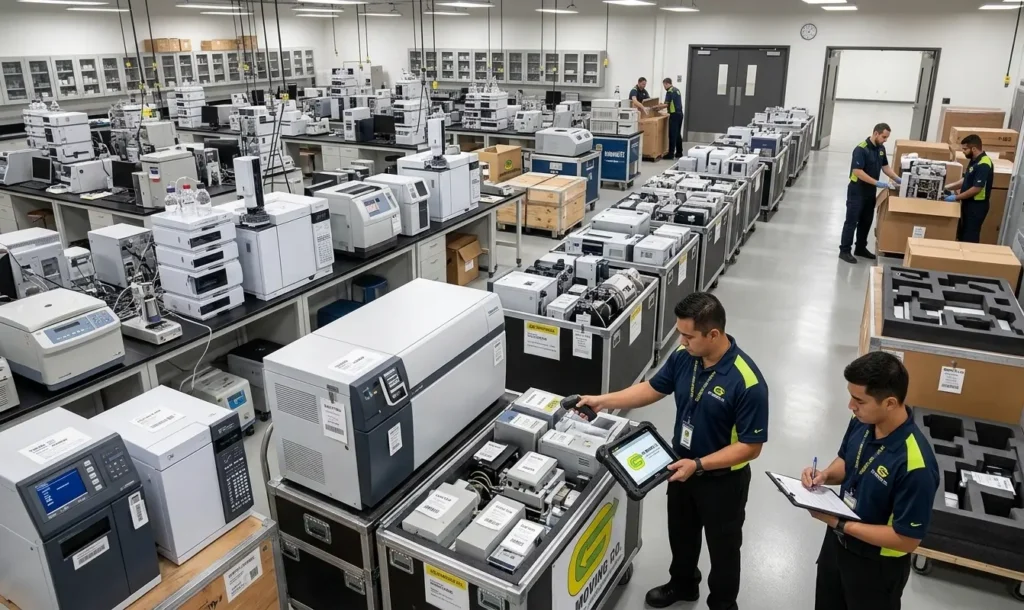
Before anything gets packed, we walk the lab with the client and assign a unique ID to every instrument, container, and crate. Each item gets a condition note, a value tier, and any special handling instructions, then gets grouped by where it’s going in the new space rather than where it currently sits. We confirm that list against the lab’s own equipment records before moving day, so there are no surprises about what’s actually in scope.
- A unique ID assigned to every instrument, container, and crate
- Condition, value tier, and handling notes recorded for each item
- Items grouped by destination room or workflow area
- The full list confirmed against the lab’s own equipment records
How is the inventory tracked during the move?
Checking IDs at pickup, in transit, and again on delivery.
Every item gets checked against its ID when it’s loaded, and a manifest travels with the shipment the whole way. On the other end, the same check happens again before anything comes off the truck. If something doesn’t match, we flag it immediately, not after the crew has left and everyone’s moved on to the next task.
- Each item checked against its ID when loaded
- A manifest, digital or paper, that travels with the shipment
- The same check repeated at unloading
- Discrepancies flagged on-site, not after the fact
What happens when hundreds of instruments arrive at once?
A staged unloading plan matched to the new floor plan.
Unloading hundreds of instruments at once only works with a plan for where each one goes before the truck doors open. We stage items by destination zone, matching the new floor plan, instead of unloading in whatever order they come off the truck. The full inventory gets reconciled before the crew leaves the site, which is also when decommissioning status matters, since why decommissioning has to happen before inventory tagging starts affects how cleanly this last step goes.
How does this differ from a smaller lab move?
Scale changes the method, not just the amount of work.
Scale changes more than the headcount on a move. It changes the method itself, from how items get identified to how unloading gets staged.
Factor | Small Lab Move (Under 20 Items) | Multi-Hundred-Instrument Move |
Inventory method | Simple list, manual check-off | Tagged assets with a running digital manifest |
Staffing | A few movers, one point of contact | A dedicated inventory lead plus the move crew |
Unloading | A single pass | Staged unloading matched to floor plan zones |
A move involving hundreds of instruments holds together because every item has a tracked identity from the first day of planning through the last box unloaded. To talk to us about a large-scale lab move, reach out to our team.
Frequently Asked Questions
Who signs off on the final inventory count before the crew leaves the site?
Both the lab’s own manager or PI and CG Moving Company’s inventory lead confirm the final count together before the crew leaves. This joint sign-off is what closes out the reconciliation step rather than leaving it to either side alone.
What happens if an instrument is found damaged during an inventory check?
It gets flagged immediately and documented with photos against that item’s unique ID, and the lab’s point of contact is notified on the spot rather than after the crew has left. This keeps the record tied to a specific moment in the move instead of a vague after-the-fact report.
Does the inventory system account for instruments being decommissioned rather than moved?
Yes, items marked for decommissioning get their own status tag in the inventory so they’re tracked separately from equipment that’s actually relocating. This connects directly to why decommissioning has to happen before inventory tagging starts, since the two processes rely on the same asset list.
Do you give the lab a copy of the inventory manifest after the move is complete?
Yes, we provide a digital copy of the full manifest so the lab can reconcile it against their own equipment records independently. This gives the client their own documentation beyond the on-site sign-off.
Planning a lab relocation with a large instrument count? Reach out to our team and we’ll build an inventory process around your specific equipment list.