Instrument decommissioning comes first in a lab move because equipment that isn’t properly powered down, drained, or disconnected can be damaged in transit, or can put the crew moving it at risk. CG Moving Company schedules decommissioning as its own step, ahead of any packing, on every biotech and pharmaceutical relocation project we run. Skip it, and a broken instrument at the new site is usually the result.
What does decommissioning actually involve?
Powering down, draining fluids, removing consumables, and logging settings.
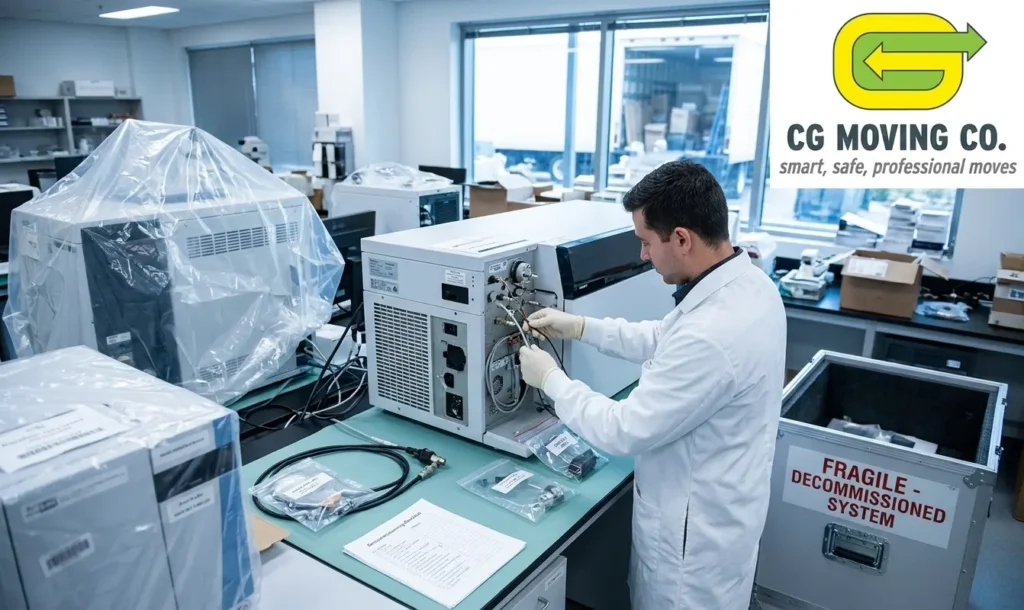
Decommissioning means taking an instrument out of its running state in a controlled way, following the steps that instrument’s manufacturer or the lab’s own procedure calls for. That usually includes shutting down in the correct sequence, draining any fluids or gases, removing or securing consumables, and recording the settings so the instrument can be configured the same way again.
- Power down following the manufacturer’s sequence
- Drain any fluids, gases, or coolant lines
- Remove or secure consumables and calibration parts
- Photograph and record current settings and configuration
Who should decommission an instrument, the lab or the mover?
Usually the lab or a service vendor; movers coordinate the schedule.
For specialized instruments like mass spectrometers, sequencers, or biosafety cabinets, decommissioning is typically handled by the lab’s own staff or the instrument’s service vendor, because it takes specific knowledge of that piece of equipment. For simpler equipment, our crew can decommission under the lab’s sign-off. Either way, we build the decommissioning schedule into the overall move plan so nothing gets left until the last minute.
What happens if decommissioning gets skipped?
Leaks, damaged parts, and recalibration delays at the new site.
An instrument that’s moved without being decommissioned properly tends to show the damage after it arrives, not before. Fluids left in a line can leak and damage the instrument or whatever else is near it in the truck. Parts that aren’t secured can shift and crack. Some service agreements are voided if an instrument is moved outside the manufacturer’s procedure, which turns a moving problem into a warranty problem.
- Leaked fluids can damage the instrument and nearby cargo
- Unsecured components can shift and break in transit
- Warranty or service agreements may be affected
- Recalibration takes longer when damage has to be diagnosed first
How does decommissioning fit into the overall move timeline?
It happens days before the move, never on moving day itself.
Decommissioning needs its own window on the calendar, separate from packing and separate from the move itself. We’ve found this sequencing holds up across most lab moves, including the kind of multi-instrument project we describe in how asset inventory works on a multi-hundred-instrument lab move.
Task | When It Happens |
Decommissioning | Days before moving day |
Packing and labeling | One to two days before moving day |
Transport | Moving day |
Reinstallation and recalibration | Days after arrival |
Decommissioning is the step that makes everything after it go smoothly, which is why we treat it as its own phase rather than something squeezed in before packing starts. To plan your instrument decommissioning timeline, reach out to our team.
Frequently Asked Questions
Does Every Piece of Lab Equipment Need to Be Decommissioned?
Not everything needs a full decommissioning process. Simple equipment like shelving, basic benches, or non-powered fixtures can usually just be packed. The decommissioning step applies specifically to powered, fluid-filled, or precision instruments, things like mass spectrometers, incubators, or anything with calibration settings that would otherwise be lost. We work with the lab team to sort equipment into the two categories early in the planning process.
What Happens to the Decommissioning Records After the Move Is Finished?
The settings and configuration notes recorded during decommissioning get used again during reinstallation, so the instrument comes back online the way it was before the move. After that, the lab typically keeps those records as part of its own equipment or quality documentation, since some instruments need that history for calibration or audit purposes. We provide our notes to the lab rather than keeping them as our own separate file.
Can Decommissioning and Packing Happen on the Same Day if the Schedule Is Tight?
It’s possible, but we recommend against it when the schedule allows otherwise. Decommissioning needs to be fully finished and verified, drained, powered down, and recorded, before packing starts, since packing an instrument that still has fluid in a line or hasn’t been properly shut down is exactly the situation that causes damage. If a tight timeline forces both into one day, we sequence decommissioning first and confirm it’s complete before any packing begins.
Who Arranges a Service Technician if an Instrument Needs Manufacturer-Specific Decommissioning?
That’s typically arranged by the lab directly with the instrument’s manufacturer or service contract holder, since the technician needs specific training on that model. We coordinate our moving schedule around the technician’s visit rather than trying to perform that specialized work ourselves. Letting us know as early as possible which instruments need a service technician helps us build a realistic timeline.
If you’re not sure which instruments on your inventory need full decommissioning, send us the list and we’ll help you sort it out before the schedule gets locked in.