Moving into or out of a walk-up building without an elevator changes the timeline, the crew size, and sometimes the equipment needed, compared with a building that has one. At CG Moving Company, we plan residential moves into walk-up buildings differently from the start, rather than treating stairs as a minor detail.
How Much Longer Does a Walk-Up Move Actually Take?
Often one to two hours longer than a comparable elevator move.
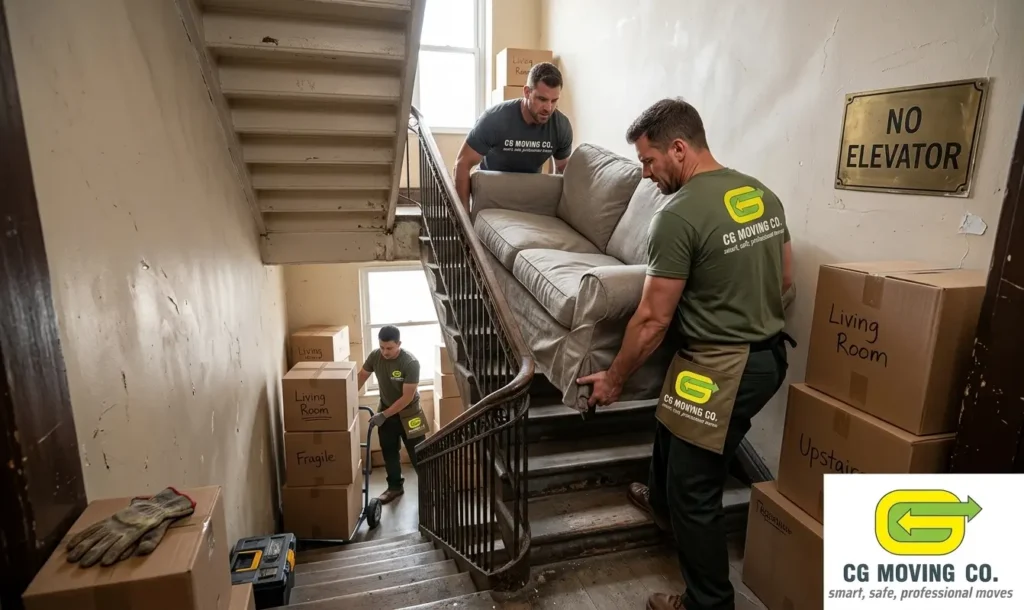
Stairs add time in a way that’s easy to underestimate until you’ve actually moved a couch up three flights. A walk-up move, compared to an elevator building at the same floor level, often takes one to two additional hours, and that gap grows with each additional flight. This isn’t about effort alone. Stairs also slow down the pace at which boxes and furniture can move, since only one trip can happen on the stairwell at a time.
Does a Walk-Up Move Need a Bigger Crew?
Often yes, to keep stairs moving efficiently without bottlenecks.
Walk-up moves often benefit from an additional crew member compared to the same job in an elevator building, mainly to keep a steady flow of items moving up or down the stairs without one carrier becoming a bottleneck for the whole team. The exact crew size still depends on floor count, furniture volume, and stairwell width, which is why these details matter during your estimate rather than being treated as an afterthought.
What Equipment Changes for a Stairs-Only Move?
Stair rollers, extra furniture straps, and careful dolly use.
Certain equipment becomes more important on a stairs-only move. Stair rollers help ease heavier furniture down flights without excessive strain, extra furniture straps distribute weight more safely on uneven steps, and dollies get used carefully, since not every staircase accommodates one well on every flight. None of this is unusual for an experienced crew, but it does mean the right equipment needs to be on the truck from the start.
Are There Items That Become Harder to Move Without an Elevator?
Large furniture, appliances, and anything heavy gets notably harder.
Large furniture, major appliances, and heavy boxes of books or tools become noticeably harder to move without an elevator, and some oversized pieces may need to be partially disassembled to navigate tight stairwells or landings safely. How long a local move actually takes depends heavily on this factor, often more than the overall size of the home.
What Should You Tell Your Movers Ahead of a Walk-Up Move?
Floor number, stair count, and any tight turns or landings.
Before your move, tell your crew the exact floor number, the total number of stairs or flights, and anything unusual about the stairwell, like tight turns, narrow landings, or low ceilings. The more specific this information is, the better CG Moving Company can plan crew size and equipment ahead of time, rather than adjusting on the fly once the truck arrives.
Factor | Building With Elevator | Walk-Up Building (No Elevator) |
|---|---|---|
Typical added time | Minimal, assuming reasonable elevator access | Often one to two hours added, depending on floor |
Crew size considerations | Standard crew size usually sufficient | Often benefits from an additional crew member |
Equipment used | Standard dollies and straps | Stair rollers, extra furniture straps, careful dolly use |
Hardest items to move | Rarely an issue with elevator access | Large furniture, appliances, and heavy boxes |
A walk-up building changes the practical details of a move, mainly time, crew size, and equipment, but it doesn’t change what’s possible with the right planning. If your move involves stairs and no elevator, let our team know the details in advance so we can staff and equip the job correctly from the start.
Frequently Asked Questions
Does it matter whether the walk-up is on the move-out end or the move-in end?
It matters at both ends, since stairs slow down loading just as much as unloading. If both your old and new address are walk-ups, we plan for the added time on both sides rather than assuming it only affects one leg of the move. Tell us about stairs at either address when you book.
Can a spiral staircase or very narrow stairwell be a problem even with a smaller crew?
Yes, a spiral staircase or a stairwell narrower than standard can slow a move down regardless of crew size, since only one person can safely navigate certain turns at a time. In some cases, oversized furniture simply will not fit around a tight spiral turn and needs an alternate route, like a window or balcony lift. We ask about stairwell width and shape specifically for this reason.
What if other tenants also use the same stairwell during my move?
We work around shared stairwells by scheduling pauses and staying alert to other residents using the stairs at the same time, rather than blocking the path for an extended stretch. This is common in walk-up apartment buildings with multiple units sharing one entrance. Letting us know the building has shared access helps us plan crew movement accordingly.
Does moving without an elevator change which day or time slot works best?
It can, since walk-up moves benefit from starting earlier in the day to leave room for the extra time stairs add before building quiet hours or parking restrictions kick in. We factor this into scheduling once we know a building has no elevator. This matters most for moves with a long flight count or a tight parking window outside.
If your move involves stairs and no elevator, give us the specifics ahead of time so we can staff and equip the job right from the start.