Which regulator oversees your move depends entirely on geography, not on the size of your home or the company you hire. CG Moving Company operates under both California intrastate authority and federal operating authority, because we handle moves that stay within the state and moves that cross state lines. Knowing which set of rules applies to your specific move matters if something goes wrong and you need to know where to turn, a topic we also cover in our guide on what makes a mover licensed and insured in California.
When does CPUC authority apply to your move?
CPUC rules apply when your move starts and ends inside California.
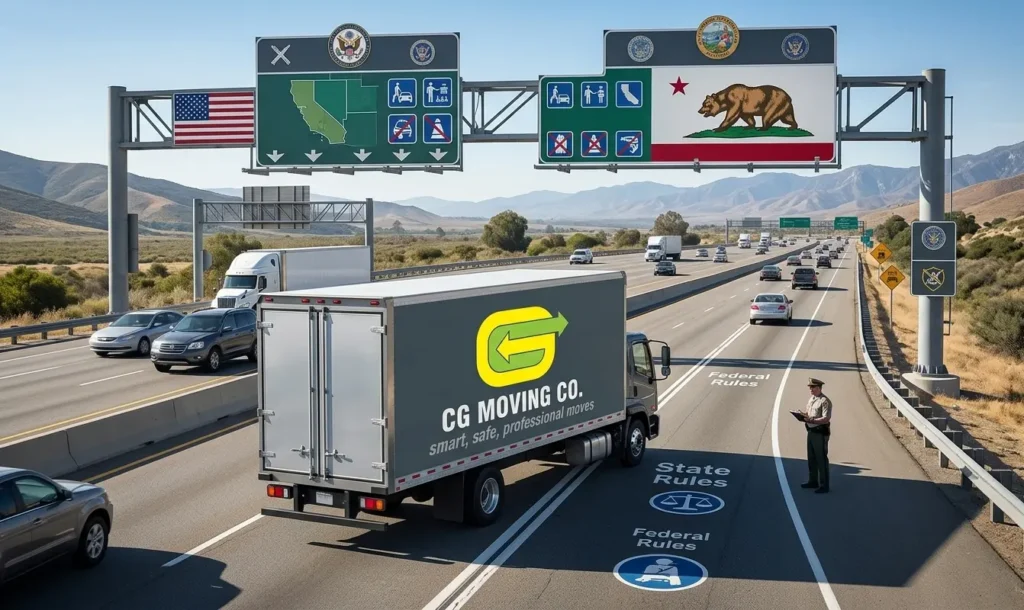
The California Public Utilities Commission regulates household goods carriers operating entirely within the state, and its consumer support page explains how this oversight works and how to verify a mover’s standing (https://www.cpuc.ca.gov/consumer-support/moving/). If you’re moving from one Bay Area city to another, this is the authority that governs your mover.
When does federal authority apply instead?
Federal rules apply when your move crosses a state line.
A move that starts in California and ends in another state, or vice versa, falls under federal interstate operating authority rather than state tariff regulation. The mover needs separate federal authority to legally handle that kind of move, on top of any state-level licensing.
Why does it matter which authority governs your move?
It determines which agency handles complaints and which rules set liability.
If a dispute comes up over pricing, damage, or delivery, the applicable authority affects where you file a complaint and what rules the mover was supposed to follow in the first place. A mover operating outside its actual authority for your specific move is a serious problem, not a technicality.
Can one moving company hold both kinds of authority?
Yes, many movers hold both, covering both local and cross-state work.
A company that handles both Bay Area local moves and relocations to other states needs to hold state intrastate authority and federal interstate authority at the same time, with both kept current. Holding one does not substitute for the other, and a mover should be able to tell you plainly which authority covers your specific move.
CPUC (state) authority | Federal operating authority | |
Applies to | Moves starting and ending in California | Moves crossing state lines |
Regulator | California Public Utilities Commission | Federal Motor Carrier Safety Administration |
What to check | Mover’s state permit status | Mover’s federal operating authority number |
Knowing whether your move is a California intrastate move or an interstate move tells you exactly which authority to check and where to turn if something goes wrong. For a closer look at the specific numbers a mover should be able to show you, see our guide on what a mover’s MTR and federal operating authority numbers actually verify, or contact CG Moving Company with questions about your specific route.
Frequently Asked Questions
What if a move starts in California, has a storage stop in California, and then continues to another state?
That move falls under federal interstate authority overall, since the final destination is out of state, even though a portion of the logistics happens within California. The storage stop doesn’t change which authority governs the shipment; the origin and ultimate destination do.
How can we check a specific mover's CPUC or federal authority status ourselves before booking?
The CPUC’s consumer support page lets you look up a mover’s state permit status directly, and the Federal Motor Carrier Safety Administration maintains a similar lookup for federal operating authority numbers. Checking either one takes a few minutes and is worth doing before you commit to a mover for either type of move.
Does moving between two Bay Area cities in different counties change which authority applies?
No, county lines don’t matter for this determination. As long as both the origin and destination are within California, CPUC intrastate authority applies regardless of how many counties or cities the route crosses.
If a mover only holds federal authority, can they still legally handle a move that stays entirely within California?
Generally no. A mover needs CPUC intrastate authority specifically to handle moves that start and end within the state, separate from whatever federal authority they hold for interstate work. Holding federal authority alone doesn’t cover a purely in-state job.
Unsure which authority applies to your specific route? Contact CG Moving Company and we’ll confirm it before you book.