Guessing at storage size is how people end up paying for a unit twice as big as they need, or renting a second one mid-move because the first filled up. At CG Moving Company, we size storage the same way we estimate a truck: by home size first, then by the specific furniture and boxes involved. If you’re unsure whether your timeline even calls for storage, our comparison of short-term versus long-term storage is worth reading first.
How does home size translate into storage space?
Home size gives a starting estimate, then furniture and boxes refine it.
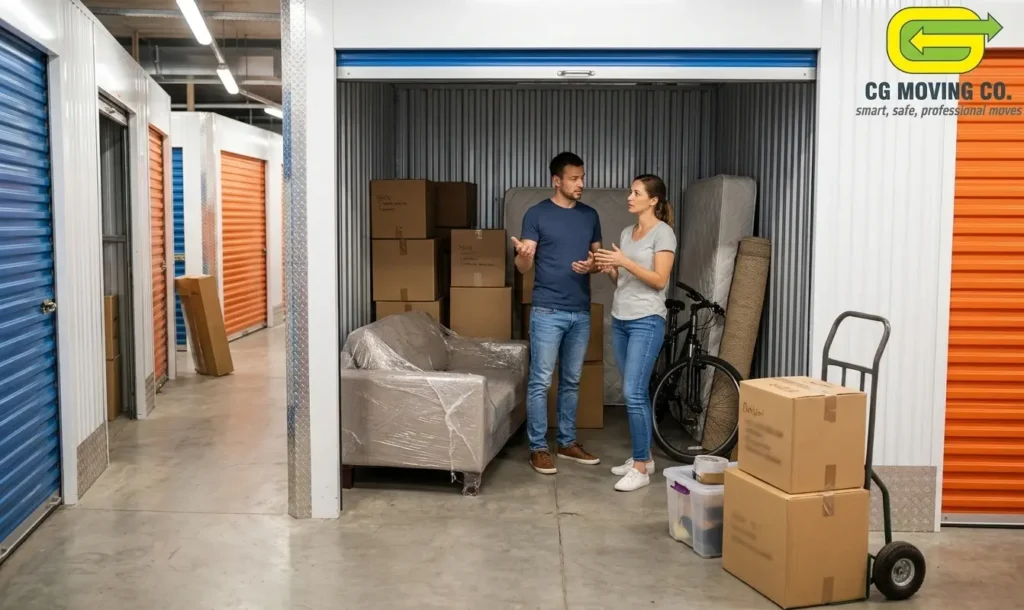
A studio or one-bedroom apartment typically needs a small unit, a three- or four-bedroom house needs something closer to a one-car or two-car garage’s worth of space, and anything larger usually needs a custom estimate. These are starting points, not final answers, because two three-bedroom homes can hold very different amounts of furniture.
What specific items push a storage estimate up?
Large furniture, appliances, and oversized boxes use space faster than expected.
A few bulky pieces can throw off a size estimate more than dozens of standard boxes, because furniture rarely stacks efficiently.
- Sofas, mattresses, and large upholstered furniture
- Appliances like refrigerators, washers, and dryers
- Dining sets and large case furniture such as armoires
- Oversized or irregularly shaped boxes that waste stacking space
Should you size up or size down if you're unsure?
Size slightly up for furniture-heavy moves, down for mostly boxed households.
If your home is furniture-heavy relative to its square footage, lean toward the next size up rather than squeezing everything in tightly, since tightly packed storage is harder to access and more prone to damage. If most of what you own fits in boxes, a smaller unit than the home-size rule of thumb suggests is usually fine.
Does online inventory access change how you should size a unit?
Yes, visibility into what’s stored lets you size tighter with less risk.
When you can look up exactly what’s in storage instead of guessing, there’s less reason to pad your estimate for uncertainty. Our piece on how online inventory access changes what storage is good for covers this in more depth.
The right storage size comes down to an honest look at your furniture, not just your square footage. Contact our team with a rough inventory and we’ll size your unit before moving day, not after boxes are already piling up.
Frequently Asked Questions
Can you move from a smaller storage unit to a larger one if you underestimate?
Yes, we can arrange a transfer to a larger unit if your original estimate turns out to be too small. It’s best to flag this as soon as you notice it filling up rather than letting items overflow or get crammed in.
Do stackable bins save more storage space than standard moving boxes?
Generally yes, uniform stackable bins use vertical space more efficiently than a mix of mismatched box sizes, which helps a tight estimate go further. This matters most when you’re already sizing close to the edge of a unit.
Should furniture be stored assembled or disassembled to save space?
Disassembled where it’s practical to do so, since bed frames, large tables, and similar pieces take up noticeably less room broken down than assembled. Our crew can handle the disassembly as part of loading your storage unit.
How much extra space should you plan for if you expect to add items to storage later?
A modest buffer beyond your current estimate is reasonable if you know more items are coming, rather than sizing exactly to what you have today. Mention this expectation when you’re setting up the unit so it’s factored in from the start.
Not sure which size fits your household? Contact our team with a rough inventory and we’ll size your unit before moving day.